“HOW DO I MAKE SURE MY KIRRIBILLI PLUMBER DOESN’T FREAK OUT MY PET ROSELLA? OR VICE VERSA?”
Let’s address the elephant—or rather, the parrot—in the room.

You live in Kirribilli. You have a pet rosella(one of the 4 types of Rosella!). You have a plumbing emergency. These three facts should not be mutually exclusive, but somehow, they’ve collided into a perfect storm of screeching, feathers, and rapidly rising blood pressure.
Your rosella, let’s call him Cedric, is a majestic creature. He has plumage that would make a sunset jealous. He also has the temperament of a disgruntled bouncer and the lung capacity of an opera singer. He does not appreciate strangers. He really doesn’t appreciate strangers with tools.
And now you’ve got Gary the plumber arriving in approximately seventeen minutes, and you’re staring at Cedric’s cage, thinking: Who’s going to freak out first—the bird or the bloke?
Here’s the thing. “Rosella” isn’t just one bird. It’s a whole genus—Platycercus, the broad-tailed parrots of Australia—and depending on which one you’ve got, your plumber survival strategy may need adjusting. There are six species in total, but for simplicity, we can talk about four main types based on cheek color and geography. Cedric, based on his dramatic flair, is probably one of these:
https://sites.google.com/view/birds-of-australia/the-4-types-of-rosellas
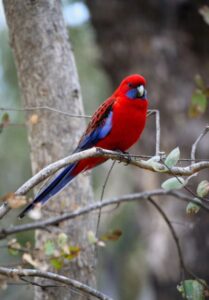
1. The Crimson Rosella (Platycercus elegans). This is the classic. Rich crimson body, brilliant blue cheeks and shoulders, black-mottled wings. They’re found in southeastern Australia, from Queensland down through New South Wales, Victoria, and into South Australia. Juveniles are a startling olive-green before they molt into adult colors—a fact that has confused many a new bird owner into thinking they bought the wrong species . https://sites.google.com/view/birds-of-australia/the-4-types-of-rosellas/the-crimson-rosella
Crimson Rosellas are bold, adaptable, and common in suburbs, which means they’re used to humans but not necessarily fond of them. If Cedric is a Crimson, his bouncer energy is textbook.
2. The Eastern Rosella (Platycercus eximius). Also called the Rosehill Parakeet historically—the name “rosella” actually comes from Rose Hill, near Parramatta, where early settlers first encountered them . These are the ones with the striking red head and breast, white cheeks, and that scalloped black-and-yellow back pattern. They’re native to southeastern Australia and Tasmania. Eastern Rosellas are widely kept as aviary birds, and here’s a relevant fact: male Eastern Rosellas are notorious for aggression, especially during breeding season. They will fight through cage wire, sometimes injuring or even killing neighboring males, and can turn on their own mates . If Cedric is an Eastern, Gary the plumber’s odds just got worse.
https://sites.google.com/view/birds-of-australia/the-4-types-of-rosellas/eastern-rosellas
3. The Pale-headed Rosella (Platycercus adscitus). Found in northeastern Australia, these are the softer-looking ones—pale cream or yellow head, blue cheeks, and a mix of blue, yellow, and red on the body. They’re less intensely red than Crimsons or Easterns, and in captivity they have a reputation for being a bit more laid-back than their fiery cousins . If Cedric is a Pale-headed, you might have slightly more time before the screaming starts. Might. https://sites.google.com/view/birds-of-australia/the-4-types-of-rosellas/the-pale-headed-rosella
4. The Western Rosella (Platycercus icterotis). The odd one out. Found only in southwestern Western Australia, these are the smallest rosellas, with yellow cheek patches (hence “icterotis,” roughly meaning “yellow-eared”) and a distinctly different body plan. Molecular studies place them as a basal offshoot—they diverged from the other rosellas early on . They’re less commonly kept outside Australia, so if Cedric is a Western, you’ve got a relatively rare bird on your hands. Also, his temperament might be slightly less intense than the eastern species, though that’s a low bar. https://sites.google.com/view/birds-of-australia/the-4-types-of-rosellas/the-western-rosella
Now, the practical bit. Rosellas across the board are not cuddly parrots. They’re independent, intelligent, and often nippy. They don’t appreciate being grabbed or petted, and they bond on their own terms . Male rosellas in particular can become aggressive as they mature—sometimes around eighteen months, a hand-fed male who was perfectly tame will suddenly decide he’s had enough of your nonsense and start biting . Cedric’s “disgruntled bouncer” routine isn’t a phase. It’s a lifestyle.
They’re also loud. Not constantly, but enthusiastically—especially in the morning and evening. That “opera singer” lung capacity is real . A startled or territorial rosella can produce a call that will make Gary drop his wrench.
So when Gary knocks, here’s what you’re working with: a bird that is either a Crimson (bold, suburban-savvy, not impressed), an Eastern (potentially aggressive, definitely territorial), a Pale-headed (maybe slightly mellower, still a parrot), or a Western (rare, small, still not a lap bird). In all four cases, the bird is going to be the one calling the shots. Gary’s just the bloke with the pipe wrench.
[Menu]
Here’s how to ensure peace in the Kirribilli household.
Step 1: The Pre-Game Briefing
 You cannot just spring this on a plumber. That’s how wars start.
When Gary arrives, do not greet him with, “Oh, by the way, there’s a bird.” That’s like saying, “Oh, by the way, there’s a crocodile.” He needs preparation. He needs context. He needs a full Situation Report.
Meet him at the door. Look him dead in the eye. Say, with absolute seriousness: “Gary, before you enter, I need you to understand something. There is a crimson rosella in my lounge room. His name is Cedric. He has opinions. He will share them with you. Do not make direct eye contact for longer than three seconds. Do not wear anything red—he finds it threatening. And for the love of God, do not whistle. He considers that a challenge.”
Gary will look at you like you’ve just asked him to disarm a bomb. Good. He’s appropriately scared.
Step 2: The Cage Placement Tango
The location of Cedric’s cage is absolutely critical. You cannot have him in the same room as the plumbing action. This is non-negotiable.
If Gary is working on the kitchen sink, Cedric’s cage needs to be in the bedroom. If Gary is working in the bathroom, Cedric needs to be on the balcony (weather permitting—Cedric is a Kirribilli rosella, he has standards).
The goal is distance. The further Cedric is from the action, the less he can see, the less he can commentate, and the less Gary has to explain to his boss why he’s been screeched at for three hours.
Step 3: The Noise Management Strategy
Here’s where it gets tactical.
Gary is going to make noise. Drills. Wrenches. The occasional muttered curse when a pipe fights back. Cedric is going to respond to this noise by attempting to out-sing it. This is not a competition Cedric can win, but he will die trying.
Solution? Background noise.
Turn on the TV. Put on some gentle jazz. Play a nature documentary—but NOT one with birds, because that will send Cedric into a frenzy of territorial rage. Pick something boring. Something about geology. Cedric will be confused, maybe a little offended, but he’ll calm down out of sheer disappointment.
And if Gary starts whistling while he works? Stop him immediately. Tell him, “Gary, I’m sorry, but Cedric considers whistling a declaration of war. Please hum. Quietly. In a minor key.”
Step 4: The “Don’t Poke the Bird” Rule
This should be obvious. But you’d be surprised.
When Gary takes a break, he’s going to want to look at Cedric. Because Cedric is stunning. He’s a walking rainbow. Everyone wants to look at him.
But looking is one thing. Poking is another. Tapping the cage is a third, far more dangerous thing. And making kissy noises? That’s a death wish.
Brief Gary on the “Look But Don’t Touch” policy. Explain that Cedric has a personal space bubble of approximately two metres. Explain that Cedric has bitten a postman, a real estate agent, and a very overconfident cockatoo. Gary will respect the bubble.
Step 5: The Screech-Off Contingency
Despite your best efforts, it will happen. Cedric will screech. Gary will jump. Gary will drop his wrench. The wrench will clatter. Cedric will screech LOUDER. It’s a feedback loop of chaos.
Here’s what you do.
You walk calmly to Cedric’s cage. You look him in the eye. You say, “Cedric, we have discussed this. This man is here to fix the water. He is not a rival. He is not a predator. He is a service provider.”
Cedric will pause. He’ll tilt his head. He’ll consider your words. Then he’ll screech one more time, just to have the last word, because he’s a rosella and that’s what they do.
And then? Silence. He’s made his point. He’s asserted dominance. Gary can continue.
Step 6: The Introduction (Optional, High-Risk)
If, against all odds, Gary and Cedric seem to be getting along—if Gary has demonstrated respect, if Cedric has stopped hissing—you might attempt a formal introduction.
Hold out your hand. Let Cedric step onto your finger. Bring him, slowly, toward Gary. Let Gary offer a single, unsalted, unshelled sunflower seed.
If Cedric takes it? You’ve achieved the impossible. You’ve created a Kirribilli miracle. Gary is no longer just a plumber—he’s been accepted. He’s part of the flock.
If Cedric lunges? Abort. Abort immediately. Retreat. Try again next plumbing emergency. Or never. Never is also fine.
The Ultimate Test
How do you know you’ve managed this situation successfully?
When Gary finishes the job, he’s not bleeding. Cedric is not traumatised. The leak is fixed. And as Gary packs up his tools, he glances at Cedric’s cage and says, “He’s actually not that bad. Reminds me of my ex-wife.”
You’ll laugh nervously. Cedric will screech once. And you’ll know—everything is going to be just fine.
Just don’t mention the ibis. Nobody mentions the ibis.